
Why do high-volume production lines still struggle with bond strength inconsistencies and material waste when robotic adhesive dispensing systems are more advanced than ever? The reality is that even the most sophisticated 6-axis arm cannot compensate for a poorly engineered integration strategy. You’re likely familiar with the frustration of manual application errors or the persistent fear that a new custom line will fail to meet its cycle time targets. These risks are real, and they directly impact your operational stability and structural integrity.
It’s understandable to approach these technical hurdles with caution, as the cost of integration failure is too high to ignore. This 2026 guide provides the technical criteria and strategies required to deploy high-precision systems that achieve zero-defect results. We’ll examine how 3D modeling and automated machine simulation serve as a definitive insurance policy for your investment. By the end of this article, you’ll understand how to bridge the gap between complex design and seamless physical execution, ensuring your automation delivers the reliability and speed your facility requires.
Key Takeaways
- Identify the optimal robot kinematics for your application by evaluating the specific precision of Cartesian systems against the versatility of 6-axis robots.
- Utilize 3D modeling and automated machine simulation as a technical insurance policy to identify reach issues and verify cycle times before physical deployment.
- Master the selection criteria for robotic adhesive dispensing systems, ensuring meter-mix ratios and valve types are perfectly calibrated to your material viscosity.
- Eliminate the structural risks associated with manual application by implementing high-precision automated beads that guarantee consistent bond strength.
- Protect your investment through a single-partner integration strategy that combines custom engineering with long-term machine service and lifecycle support.
The Evolution of Adhesive Dispensing: From Manual to Robotic Precision
Manual application is fraught with variables that compromise the final product. Even the most skilled technician faces physical fatigue, leading to inconsistent bead volumes and missed targets over an eight-hour production window. These inconsistencies aren’t merely aesthetic; they’re structural liabilities. When a bead is too thin, the bond fails. When it’s too thick, it creates squeeze-out that requires costly secondary cleanup and wastes expensive material. Robotic adhesive dispensing systems solve this dilemma by decoupling the dispensing process from human variability, ensuring that every part meets the same rigorous standard.
The integration of multi-axis movement allows these systems to navigate intricate 3D geometries with micron-level precision. Whether the application involves a curved automotive windshield or a complex aerospace composite, the robot maintains a constant distance and angle to the substrate. This geometric flexibility is what allows modern production lines to scale while maintaining the highest quality benchmarks. By choosing robotic manufacturing systems, facilities can transition from erratic manual processes to a stabilized, data-driven assembly environment.
The Impact on Structural Integrity
Does a consistent bead placement actually correlate to joint strength? In high-stakes manufacturing, the answer is an absolute yes. Robotic adhesive dispensing systems maintain a constant flow rate and speed, which eliminates the air pockets and gaps that often plague manual application. These voids act as stress concentrators, potentially leading to catastrophic bond failure under load. By ensuring repeatable results across 24/7 production cycles, automation provides a level of quality assurance that manual processes can’t match.
Reducing Material Waste and Operational Costs
Precision fluid management is a critical component of operational profitability. When dealing with expensive structural resins or two-part epoxies, every milliliter of waste erodes the bottom line. Automated systems calculate the exact volume required for each cycle, significantly reducing the consumption of raw materials. This optimization provides a tangible ROI through lower material costs and reduced environmental impact. By minimizing chemical waste, facilities align their production goals with modern green manufacturing initiatives while protecting their margins.
Selecting Kinematics: Cartesian vs. SCARA vs. 6-Axis Robots
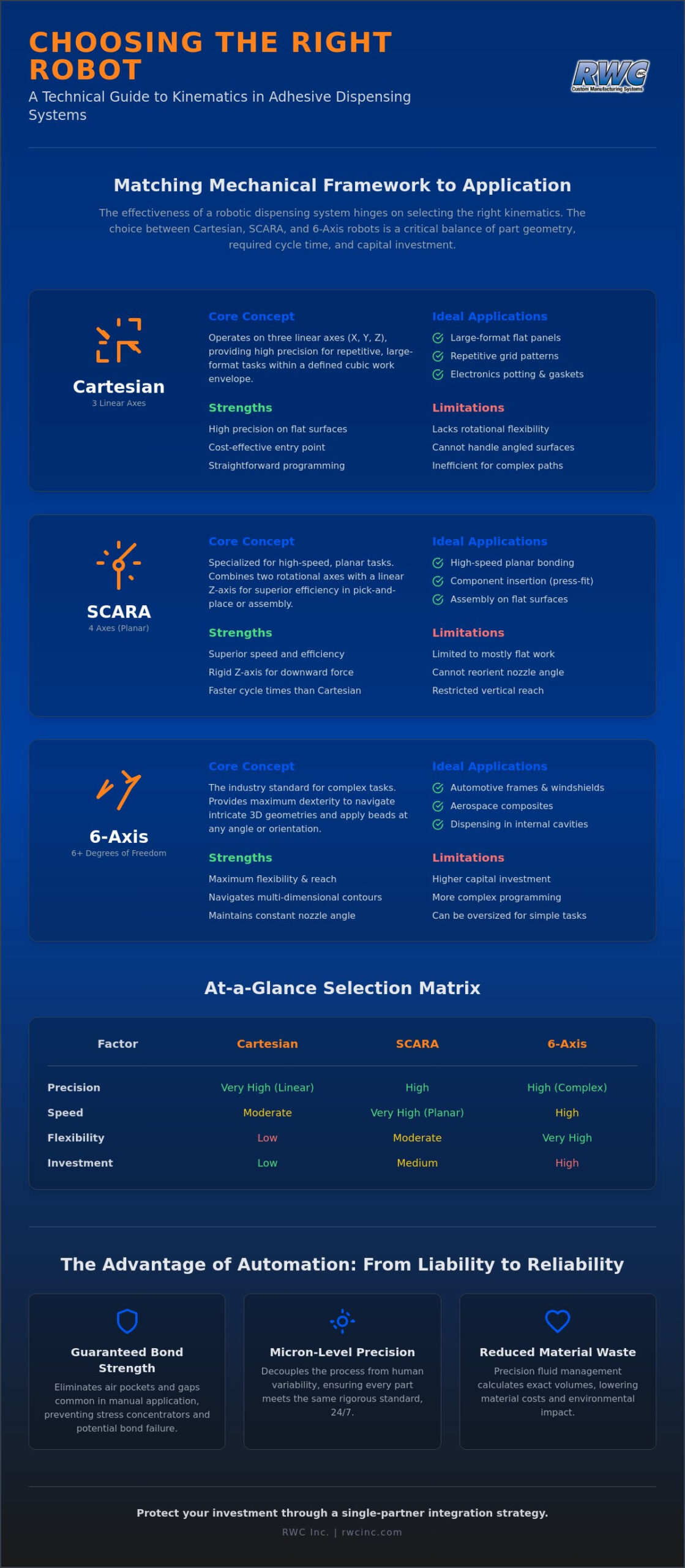
How does an engineering team determine the most effective mechanical framework for a dispensing application? The decision hinges on the complexity of the part geometry and the required cycle time. Choosing the wrong kinematics often leads to reach issues or inefficient paths that undermine the benefits of robotic adhesive dispensing systems. In the current manufacturing landscape, the selection process is a balance between the required degrees of freedom and the capital investment allocated for the cell.
Cartesian systems, operating on three linear axes, provide high precision for repetitive, large-format tasks. They are frequently the go-to choice for electronics potting or gasket application on flat panels. Industry insights on Low-Cost Robotics for Adhesive Dispensing highlight how these systems can offer a cost-effective entry point for manufacturers with straightforward linear requirements. However, they lack the flexibility to handle parts with vertical or angled surfaces that require nozzle reorientation.
For high-speed, planar bonding, SCARA robots offer superior efficiency. Their rigid Z-axis makes them ideal for applications requiring downward pressure, such as pressing a component into an adhesive-lined housing. While faster than Cartesian units, they are still limited to mostly flat-surface work. For the most demanding environments, 6-axis robotic arms remain the industry standard. They provide the dexterity needed to apply beads inside internal cavities or along multi-dimensional contours found in automotive frames and aerospace structures.
When to Choose Cartesian Systems
Cartesian robots are the logical choice for large-format flat panels or repetitive grid patterns where high-speed rotation isn’t required. Their linear nature makes programming straightforward, which reduces the time needed for initial setup and commissioning. Because the work envelope is a simple cube, it’s easier to integrate these systems into existing production lines with limited floor space. Their primary limitation is a lack of flexibility; if your part has complex 3D features, a Cartesian system will likely struggle to maintain the necessary nozzle angle for a consistent bead.
The Versatility of 6-Axis Robotic Manufacturing Systems
When an application involves complex contours or requires the robot to reach around obstacles, a 6-axis system is the only viable solution. These robots can be integrated with rotating fixtures to allow for 360-degree adhesive application without stopping the line. This capability is essential for structural bonding in the automotive sector, where adhesive must be applied to curved door frames or roof pillars. By utilizing robotic manufacturing systems designed for multi-axis movement, engineers can ensure that the dispensing tip always remains perpendicular to the substrate, which is the most critical factor in bond quality. If you are uncertain which kinematic model fits your specific production volume, consult with our engineering team to evaluate your part geometry.
Technical Specifications for Industrial Dispensing Equipment
How do engineers ensure that the material delivery matches the precision of the robot’s movement? While the robotic arm provides the path, the dispensing hardware determines the bead’s volume, consistency, and chemical integrity. In high-volume environments, robotic adhesive dispensing systems must integrate sophisticated meter-mix equipment to handle two-part epoxies and urethanes with exact stoichiometric ratios. Even a minor deviation in the mix ratio can lead to incomplete curing, which compromises the structural integrity of the entire assembly and leads to costly rework.
The selection of the dispensing valve is equally critical to the success of the cell. For low-viscosity fluids, a diaphragm valve provides a clean shut-off without dripping, whereas high-viscosity materials or those containing abrasive fillers require auger or needle valves designed for high wear resistance. These components are supported by feed systems ranging from high-pressure pail pumps for bulk consumption to pressurized cartridges for smaller, high-precision batches. For those exploring the nuances of collaborative integration, A Practical Guide to Cobot Dispensing Automation offers valuable insights into how these hardware choices adapt to different robotic platforms and safety requirements.
Handling Material Viscosity and Curing Profiles
Temperature control units are essential for maintaining stable viscosity in plants where ambient temperatures fluctuate across shifts. If the material thins too much, the bead will slump; if it thickens, the pump might fail to deliver the required volume. Additionally, automated purging cycles are a technical necessity to manage pot-life constraints. These cycles prevent the adhesive from curing inside the mixing nozzle during line pauses, which eliminates the risk of hardened material causing a system-wide blockage and subsequent downtime.
Vision Integration and Quality Control
Vision systems have evolved from simple presence detection to advanced 3D bead inspection. These sensors verify the width, height, and continuity of the adhesive bead in real-time as it is applied. By implementing a closed-loop feedback system, the controller can automatically adjust the flow rate to compensate for minor variations in travel speed or material pressure. This level of quality control provides the data logging and traceability required in regulated industries like aerospace or medical device manufacturing, where every bond must be documented for safety compliance. To further validate bond integrity at a microscopic level, engineers can explore Cube II Benchtop SEM for high-resolution material analysis.
Reducing Integration Risk with 3D Modeling and Simulation
How can a manufacturer ensure that a complex robotic cell will perform as intended before it arrives on the factory floor? The investment in robotic adhesive dispensing systems is significant, and the cost of discovering a reach limitation or a cycle time bottleneck during physical installation can be devastating. This is why 3D modeling and automated simulation are not just optional design steps; they’re an essential insurance policy against integration failure. By creating a digital twin of the entire process, engineers can validate every movement and dispense path before a single piece of steel is cut. This methodology transforms the integration from a series of guesses into a predictable, data-driven execution.
Virtual debugging allows for the identification of software conflicts and mechanical interference in a risk-free environment. When robotic adhesive dispensing systems are simulated, every joint movement is scrutinized for efficiency and safety. This process drastically reduces onsite commissioning time, as the majority of the programming and troubleshooting occurs before the physical build. It’s a methodical approach that prioritizes stability and ensures that the transition from design to physical integration is a single-partner journey without unexpected cost overruns.
The Value of Advanced 3D Modeling Services
Effective integration begins with a comprehensive spatial understanding of the facility. By utilizing 3D modeling services, manufacturers can visualize the entire robotic cell within their existing factory footprint. This process allows for the identification of potential collisions between the robot arm and tooling fixtures that might not be apparent on a 2D drawing. It ensures that the reach of the arm is optimized for the specific part geometry, preventing the need for costly onsite modifications during the commissioning phase. It’s about precision in the virtual space to ensure reliability in the physical one.
Predicting Throughput with Machine Simulation
Will the system meet its production targets? Automated machine simulation provides a definitive answer by modeling multi-robot coordination to eliminate potential bottlenecks. This environment allows engineers to test various “what-if” scenarios, such as changing adhesive types or part variations, to see how they impact the overall cycle time. By virtually debugging the system, we ensure the machinery arrives ready for immediate operation. This foresight is critical for maintaining the structural integrity of the production schedule and achieving the desired zero-defect output.
Partnering for Success: The RWC Inc. Approach to Custom Automation
Why do many automation projects exceed their budgets and timelines during the final integration phase? Often, it’s because the system was treated as a collection of disparate parts rather than a unified mechanical solution. For robotic adhesive dispensing systems, the synergy between the kinematic platform and the dispensing hardware is the most critical factor for success. RWC Inc. engineers turnkey solutions that bridge the gap between initial 3D design and final floor-ready machinery, ensuring that every component operates in harmony from the very first cycle. This methodology eliminates the technical silos that often lead to integration failure.
Sourcing components from multiple vendors creates communication gaps that can be catastrophic for production timelines. When a robot controller fails to synchronize perfectly with a third-party meter-mix system, the resulting downtime erodes profitability. By choosing a single-source partner, manufacturers mitigate these compatibility risks. Our holistic approach is particularly effective when we combine industrial adhesive bonding assembly with adjacent processes like laser welding or metal piercing and notching. This consolidation of expertise ensures that the entire cell meets the required cycle times and quality benchmarks without the need for secondary vendors.
Turnkey Integration vs. Component Sourcing
The benefits of a single-source partner extend beyond the initial build. When RWC Inc. manages the entire process from 3D modeling to physical integration, we provide a definitive path to operational stability. This turnkey model allows for seamless communication between the design engineers and the technicians on the factory floor. By identifying potential bottlenecks in the virtual space, we ensure that the physical machinery arrives ready for high-volume production. This strategy transforms a complex engineering puzzle into a predictable, value-driven asset for your facility.
Ensuring Long-Term Operational Uptime
How does a facility maintain high-precision performance years after the initial installation? The answer lies in a rigorous commitment to lifecycle support and preventative maintenance. Robotic adhesive dispensing systems require regular attention to valves, pumps, and seals to prevent material buildup and mechanical wear. RWC Inc. provides professional machine services and maintains a dedicated inventory of replacement parts to minimize manufacturing downtime. To streamline these maintenance workflows and digitize your operational records, you can explore Field Service CRM Software to ensure every service call is tracked with precision. This proactive strategy ensures that your equipment remains a stable asset, even as your production needs evolve. Having an experienced partner provides the steady hand required to navigate the risks of manufacturing cost-overruns and technical obsolescence.
Securing the Future of Your Production Line
Transitioning to automated dispensing is a strategic necessity for manufacturers aiming to ensure structural integrity while reducing operational waste. Successful deployment of robotic adhesive dispensing systems depends on a meticulous integration strategy that begins with advanced simulation and ends with reliable lifecycle support. By selecting the optimal kinematic framework and validating every path through 3D modeling, you can eliminate the risks of integration failure and inconsistent bond strength. These technical safeguards ensure that your facility achieves the zero-defect output required in high-stakes industries.
RWC Inc. has served as an authoritative expert in industrial engineering since 1945. We specialize in custom machine simulation and provide full lifecycle machine support, ensuring that your machinery remains a stable and productive asset. Our methodical approach bridges the gap between visionary design and floor-ready execution, providing the quiet confidence required to navigate complex automation hurdles. We understand the gravity of manufacturing downtime and offer the precision engineering needed to optimize your production lines for the demands of 2026 and beyond.
Your journey toward a zero-defect production environment begins with a partner who understands the intersection of innovation and practical application.
Frequently Asked Questions
What is the difference between a Cartesian and a 6-axis dispensing robot?
Cartesian robots move along three linear axes and are best for large, flat applications like electronics potting or gasket application. While they offer high precision for linear paths, they lack the dexterity to reorient the nozzle. In contrast, 6-axis robots provide the flexibility needed for complex 3D geometries. These arms can reach into internal cavities and maintain a perpendicular nozzle angle on curved substrates, which is essential for automotive structural bonding.
How does 3D modeling reduce the cost of robotic system integration?
3D modeling identifies mechanical interferences and reach limitations in a virtual environment before any physical components are manufactured. By visualizing the robotic cell within the actual factory footprint, engineers prevent costly onsite modifications and material waste. This proactive approach serves as an insurance policy, ensuring that the transition from design to physical integration is a single-partner journey without the risk of unexpected manufacturing cost-overruns or equipment redesigns.
Can robotic systems handle two-part adhesives with fast cure times?
Yes, robotic adhesive dispensing systems utilize advanced meter-mix equipment and automated purging cycles to manage materials with aggressive curing profiles. Precise stoichiometric ratios are maintained through closed-loop controls, ensuring the structural integrity of the bond. Automated purging prevents the adhesive from hardening inside the mixing nozzle during line pauses, which eliminates the risk of system-wide blockages and the resulting manufacturing downtime that often plagues manual processes.
What are the maintenance requirements for industrial dispensing equipment?
Maintenance focuses on the regular inspection of dispensing valves, pumps, and seals to prevent material buildup and mechanical wear. Proactive schedules include cleaning mixing chambers and verifying the calibration of flow sensors to ensure consistent bead volume. Utilizing custom-engineered replacement parts is essential for system longevity, as these components are designed to withstand the specific pressures and abrasive fillers common in high-performance structural resins and epoxies.
How do vision systems improve the quality of adhesive bonding?
Vision systems provide real-time, 3D bead inspection to verify the width, height, and continuity of the adhesive as it is applied to the substrate. These sensors detect gaps or volume deviations that could compromise joint strength, triggering immediate adjustments through closed-loop feedback. This level of quality control ensures zero-defect output and provides the data logging required for traceability in regulated industries like aerospace and medical device manufacturing.
Is simulation necessary for every custom robotic cell build?
Simulation is a critical step for any custom integration where cycle time and reach are vital for operational success. It allows engineers to virtually debug the robotic path and test various scenarios for different part variations without risking physical hardware. This process ensures the machinery meets target throughput benchmarks before deployment, reducing onsite commissioning time and providing a reliable, data-driven baseline for long-term performance and stability.
What industries benefit most from automated adhesive bonding?
Automotive and aerospace sectors benefit significantly due to their increasing reliance on lightweighting and the bonding of dissimilar materials. These industries require the precision of robotic adhesive dispensing systems to maintain structural integrity across complex 3D geometries. Additionally, the electronics and medical device sectors utilize automation to achieve micron-level accuracy and repeatable results in high-volume production environments where manual application is prone to human error and waste.
How does RWC Inc. support systems after the initial installation?
RWC Inc. provides comprehensive lifecycle support through professional machine services and a dedicated inventory of replacement parts to minimize downtime. We offer technical assistance to help clients adapt their systems to evolving production needs or changes in adhesive chemistry. Our role as a steadfast guide ensures that your investment remains a stable asset, backed by the expertise of a partner that has been established since 1945.

