
Is your assembly line’s structural integrity being compromised by the inherent variability of manual application? For manufacturers in high-stakes industries, the reality of inconsistent bonding and material over-application is more than a quality control hurdle; it’s a direct threat to the bottom line. You likely recognize that manual processes often lead to a high rate of rejected parts and significant material waste, creating operational bottlenecks that hinder your throughput. By automating adhesive application process stages, you can replace human inconsistency with documented precision, ultimately driving down the cost per unit while ensuring every joint meets rigorous industrial standards.
This guide demonstrates how transitioning to high-precision automated systems eliminates the guesswork that leads to production delays. We will examine the strategic methodology for integrating robotic systems into your 3D modeled production lines and how advanced machine simulation can mitigate risk, ensuring a seamless transition from manual labor to optimized, data-driven assembly.
Key Takeaways
- Understand how automating adhesive application process transitions your assembly line from manual variability to repeatable, high-precision robotic delivery.
- Identify the technical requirements for gear and piston pumps to ensure consistent bead placement regardless of material viscosity.
- Compare the scalability of operator-assisted semi-automated cells against high-volume, fully robotic turnkey systems.
- Learn how substrate analysis and material chemistry alignment are essential for achieving optimal bonding and structural integrity.
- Discover how 3D modeling and automated simulation services eliminate design flaws before physical installation begins.
The Case for Automating Adhesive Application in Modern Manufacturing
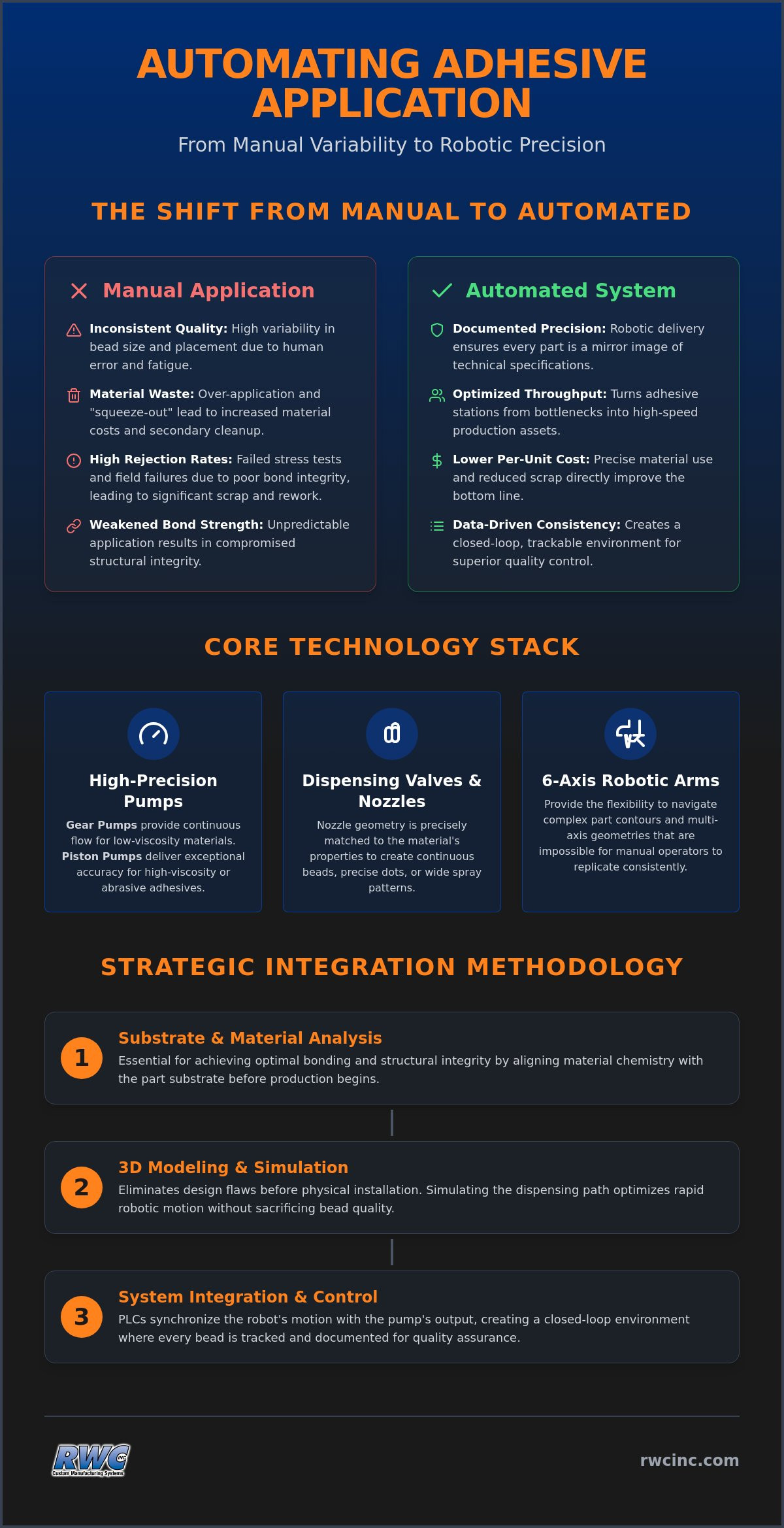
Modern industrial assembly demands more than just a bond; it requires a repeatable, data-backed application that manual methods cannot consistently provide. By automating adhesive application process workflows, manufacturers transform a variable-heavy task into a controlled robotic delivery system. This transition replaces the unpredictability of human technique with high-precision bead placement, ensuring that every part produced is a mirror image of the technical specification. In industries where structural integrity is non-negotiable, such as automotive or aerospace, the precision of the adhesive volume is a primary factor in safety and performance.
The economic drivers for this shift are as compelling as the quality requirements. Manual over-application doesn’t just waste expensive materials; it often necessitates secondary cleanup operations to remove “squeeze-out” or excess residue. Automated systems eliminate these hidden costs by delivering the exact volume required for the bond. Understanding Adhesive bonding basics is essential for recognizing why precise placement is critical to the structural integrity of safety-critical components. When the dispensing process is synchronized with robotic motion, the result is a seamless assembly line that operates at peak efficiency without the risk of human-induced variability.
Overcoming the Limitations of Manual Dispensing
Human error is an expensive variable in high-volume assembly lines. Even the most skilled operators experience fatigue, which inevitably leads to inconsistent bond strength and misaligned beads. These inconsistencies often go unnoticed until a part fails a stress test or, worse, fails in the field. Manual application is also severely limited when dealing with complex, multi-axis geometries. A robotic arm can maintain a constant distance and angle relative to a contoured surface, a feat that is physically impossible for a human operator to replicate over an eight-hour shift. This robotic consistency ensures that the adhesive performs exactly as the engineers intended, regardless of the part’s complexity.
The ROI of Adhesive Automation
The return on investment for an automated cell is found in the drastic reduction of rework and scrap rates. When you utilize high-precision metered dispensing, material savings can be calculated down to the milliliter, providing a clear path to lower per-unit costs. Furthermore, integrating 3D modeling services during the initial design phase allows manufacturers to simulate the dispensing path before a single piece of hardware is installed. This proactive approach eliminates design flaws and ensures that the system is optimized for rapid robotic motion. By synchronizing the dispensing valve with the robot’s acceleration and deceleration, throughput is increased without sacrificing the quality of the bead, turning the adhesive station from a bottleneck into a high-speed production asset.
Technical Components of a Precision Adhesive Dispensing System
Achieving a high-precision bond is a function of the hardware stack. Successfully automating adhesive application process requirements depends on selecting the right mechanical components that can withstand the rigors of high-volume production. If you require custom metal fabrication for your system’s structural components, check out Donewright Stainless. At the heart of these systems are high-precision pumps. Gear pumps provide a continuous, pulseless flow ideal for lower viscosity materials, while piston pumps offer exceptional volumetric accuracy for abrasive or highly viscous adhesives. Selecting the wrong pump type can lead to inconsistent pressure, which directly compromises the bead profile and the resulting structural integrity.
Dispensing valves and nozzles serve as the final delivery point. Whether your application requires a continuous bead, precise dots, or a wide spray pattern, the nozzle geometry must match the material’s rheology. When integrated with 6-axis robotic arms, these systems gain the flexibility to navigate complex part contours and multi-axis geometries that manual operators simply cannot reach. Modern robotic dispensing systems often include integrated vision systems and sensors. These tools provide real-time bead inspection and part registration, allowing the system to adjust its path dynamically if a part is slightly misaligned on the fixture.
Material Delivery and Fluid Management
Viscosity is highly sensitive to environmental changes. To maintain consistency, temperature-controlled delivery lines are utilized to keep the adhesive within its optimal processing window. Additionally, degasification units are often integrated to remove entrapped air, preventing voids that could lead to bond failure. For continuous, lights-out manufacturing, automated refill systems ensure that the process never stops for a manual canister change. If you’re looking to optimize your assembly line with these technologies, our team can help you evaluate your specific application requirements to ensure peak performance.
Control Systems and Software Integration
Programmable Logic Controllers (PLCs) act as the central nervous system of the adhesive cell, synchronizing the robot’s motion with the pump’s output. By integrating dispensing software with your factory’s MES or ERP systems, you create a closed-loop environment where every bead is tracked. This data logging is vital for traceability in regulated industries like aerospace or medical device manufacturing. Utilizing 3D modeling services during the design phase ensures that these software parameters are perfectly aligned with the physical hardware before the build begins, reducing the risk of integration delays.
Comparing Semi-Automated vs. Fully Robotic Adhesive Cells
Manufacturers often face a critical junction when deciding between semi-automated and fully robotic configurations. The choice isn’t merely about budget; it’s about the required throughput and the complexity of the assembly itself. When automating adhesive application process tasks, you must evaluate whether the human operator adds value through inspection or becomes a bottleneck in the production cycle. Semi-automated systems generally rely on an operator for part loading and orientation, while the machine handles the precision dispensing. In contrast, fully robotic cells are turnkey environments designed for high-volume, low-intervention production where speed and sub-millimeter accuracy are paramount. These systems are engineered to handle the most demanding mechanical requirements without the variability introduced by manual intervention.
Semi-Automated Solutions for Low-to-Mid Volume
For facilities managing diverse product lines with frequent changeovers, semi-automated solutions offer superior flexibility. Utilizing rotary tables or linear actuators, these systems allow an operator to fixture a part while the dispensing head completes a cycle on another. When you begin automating adhesive application process steps in a low-volume environment, the operator provides essential quality oversight. This setup is ideal for batches where part geometry varies or where visual confirmation is required before the next assembly stage.
Fully Robotic Systems for High-Precision Assembly
When production volumes reach a certain threshold, the transition to fully robotic manufacturing systems becomes a strategic necessity. These cells achieve sub-millimeter accuracy, maintaining bead consistency across thousands of cycles without the risk of human fatigue. A major advantage is the ability to integrate adhesive bonding with other processes. For instance, a robot can apply a structural adhesive and then immediately transfer the part for laser welding or metal piercing. This removes human interaction from chemical handling areas, significantly improving safety.
Balancing initial CAPEX with long-term operational efficiency is the final piece of the puzzle. While fully robotic cells require a higher upfront investment, the lower cost per unit and reduced scrap rates often justify the expenditure within a shorter timeframe than expected. Using 3D modeling services and automated machine simulation allows you to visualize these efficiencies before committing to a specific hardware configuration. This data-driven approach ensures that the chosen path aligns with your long-term production goals and provides a scalable foundation for future growth. By analyzing the lifecycle support and replacement parts availability, you can maintain these systems at peak performance for years to come.
Strategic Implementation: A Roadmap for Seamless System Integration
How do you ensure that a high-tech robotic cell delivers on its promise of structural integrity? The answer lies in a meticulous integration strategy that prioritizes substrate compatibility and material rheology. When automating adhesive application process steps, the chemistry of the adhesive must be perfectly matched to the dispensing hardware. For instance, a high-viscosity epoxy requires different pump pressures and nozzle geometries than a fast-curing urethane. Without this mechanical alignment, manufacturers risk cavitation or inconsistent bead profiles that compromise the final assembly. A successful roadmap moves beyond simple installation; it requires a deep analysis of how the adhesive interacts with the part surface under production speeds.
Cycle time optimization is the next critical hurdle. You must balance the speed of the robotic bead placement with the specific curing requirements of the material. If the robot moves too quickly, the bead may stretch or break; too slowly, and you risk pre-curing or skin-over before the parts are joined. Validation through both destructive and non-destructive testing ensures that the automated bonds meet the design’s safety factors. By utilizing 3D modeling services early in the planning phase, engineers can identify potential mechanical interferences and optimize the dispensing path, ensuring that the system is ready for high-volume throughput from day one.
The Importance of Surface Preparation
Prototyping and Pilot Runs
Before full-scale deployment, small-scale pilot runs are used to verify bead geometry and flow rates under actual factory conditions. These tests help identify potential bottlenecks, such as slow material refill cycles or excessive robotic air-movements, which are non-productive motions that inflate cycle times. Refining the robotic paths during this stage allows for the synchronization of the dispensing valve with the robot’s acceleration curves. This level of precision ensures that the start and end of each bead are as consistent as the middle, eliminating the “dog-bone” effect that often plagues less sophisticated systems.
RWC Inc.: Engineering Custom Adhesive Bonding Assembly Solutions
Since 1945, RWC Inc. has established itself as a definitive partner in the field of industrial automation. We leverage over 80 years of engineering expertise to solve the most intricate assembly puzzles, ensuring that our clients maintain a competitive edge in a demanding physical field. When automating adhesive application process requirements for your facility, you aren’t merely purchasing hardware; you’re investing in a legacy of precision. Our 3D modeling services allow us to eliminate design flaws before the build begins, ensuring that every bracket, nozzle, and sensor is positioned for maximum operational efficiency.
We understand the gravity of manufacturing downtime and the financial impact of cost-overruns. This is why our methodology includes advanced machine simulation to predict throughput and cycle times with pinpoint accuracy before any metal is cut. This proactive approach allows us to provide comprehensive lifecycle support, ranging from the initial design phase to the provision of custom replacement parts and dedicated machine service. By acting as a steadfast guide, we help you navigate the risks of technical integration with quiet confidence and technological sophistication.
De-Risking Integration with Machine Simulation
How can you be certain your system will perform as promised? We create a digital twin of your adhesive cell to visualize the entire process in a virtual environment. This simulation identifies potential collision risks and fluid flow issues before they ever become physical problems on your factory floor. By validating the system against performance specifications in a virtual space, we ensure a seamless transition to physical production. This process minimizes the risk of unexpected delays and ensures that the system meets your exact mechanical requirements from the moment of installation.
Custom Solutions for Complex Industrial Needs
Every manufacturing environment presents its own unique set of engineering hurdles. Whether you’re in the automotive sector or producing heavy machinery, we tailor adhesive systems to address your specific bonding challenges. We specialize in integrating multiple processes into a single robotic manufacturing system, often combining adhesive application with laser welding or metal piercing to maximize floor space and reduce part handling. This integration results in a more streamlined production line and a lower cost per unit. Contact RWC Inc. today to discuss how our custom solutions can optimize your assembly line and ensure the long-term structural integrity of your products.
Advancing Assembly Standards Through Precision Engineering
Transitioning to an automated assembly environment represents a fundamental shift from variable-heavy manual tasks to data-driven, high-precision operations. By prioritizing substrate analysis and the mechanical synchronization of dispensing hardware, manufacturers can eliminate the inconsistencies that lead to rejected parts and material waste. The strategic decision of automating adhesive application process workflows ensures that quality assurance is baked into the mechanical design, providing a repeatable foundation for long-term production success.
Since 1945, RWC Inc. has served as a steadfast partner for manufacturers facing these intricate engineering puzzles. We combine expert 3D modeling and automated machine simulation to de-risk your investment, identifying potential bottlenecks before they impact your factory floor. Our commitment extends beyond the initial installation, offering full lifecycle machine service and support to ensure your system maintains peak performance. Embracing this level of technological sophistication is the definitive answer to reducing costs while maintaining the highest levels of structural integrity.
We look forward to helping you reach new levels of manufacturing precision and operational reliability.
Frequently Asked Questions
What are the primary benefits of automating the adhesive application process?
The primary advantages include enhanced structural integrity, reduced material waste, and significantly higher throughput. By automating adhesive application process stages, you replace the inherent variability of manual labor with documented, repeatable precision. This ensures that every joint meets rigorous engineering specifications, which is vital for safety-critical components while simultaneously lowering the overall cost per unit through decreased scrap rates.
Can any adhesive material be used in an automated dispensing system?
Most industrial adhesives, including epoxies, urethanes, and cyanoacrylates, are compatible with automated systems. However, the dispensing hardware must be specifically matched to the material’s chemistry and rheology. Abrasive fillers or extremely high viscosities require specialized pump seals and nozzle geometries to prevent equipment wear. Engineering the system around the specific adhesive ensures long-term reliability and consistent bead profiles.
How much does it cost to automate an adhesive bonding assembly line?
The total investment depends on the required level of automation and the complexity of the assembly. Semi-automated systems offer a lower entry point for mid-volume production, while fully robotic cells require a higher initial capital expenditure. The return on investment is typically found in the reduction of rework, lower material consumption, and the elimination of secondary cleanup operations. A technical consultation is necessary to determine the most efficient configuration for your production goals.
What is the difference between a gear pump and a piston pump for dispensing?
Gear pumps provide a continuous, pulseless flow that is ideal for applications requiring a steady bead at consistent speeds. Piston pumps utilize a positive displacement method, making them superior for high-viscosity materials or applications requiring extreme volumetric accuracy per stroke. The choice depends on your material’s flow characteristics and whether your process demands a continuous bead or precise, metered dots.
How does 3D modeling improve the design of an automated adhesive cell?
3D modeling allows engineers to identify mechanical interferences and optimize robotic paths in a virtual environment before the physical build begins. This process ensures that fixtures, sensors, and dispensing heads are positioned for maximum efficiency and reach. By simulating the entire cell, you can eliminate design flaws early, which significantly reduces integration risks and prevents costly downtime during the installation phase.
Is a vision system necessary for automated adhesive application?
While not strictly mandatory, vision systems are highly recommended for high-precision or safety-critical assemblies. They provide real-time bead inspection and part registration, allowing the robot to adjust its path dynamically if a part is slightly misaligned on the fixture. In regulated industries, these systems act as a critical quality gate by documenting that every bead meets the specified width, length, and position requirements.
How do you handle different part sizes in a single robotic adhesive station?
Robotic stations manage multiple part sizes through flexible fixturing and programmable logic controller (PLC) recipes. Modern systems utilize quick-change grippers and adjustable tooling to accommodate various geometries within the same cell. By selecting the appropriate pre-programmed routine, the robot instantly switches its dispensing path, allowing you to run diverse product lines through a single robotic manufacturing system without extensive mechanical reconfiguration.

