
The most critical phase of a successful laser welding installation occurs in a virtual environment long before a single robot is bolted to your facility floor. You likely recognize that the complexity of synchronizing high-power fiber lasers with multi-axis robotics often leads to unforeseen downtime and expensive integration errors. It is a high-stakes investment where even a minor misalignment in the beam path can result in significant scrap rates and missed production targets.
This article provides a strategic roadmap for achieving a seamless laser welding system integration through advanced 3D simulation and precision engineering. You’ll discover how to leverage automated machine simulation to predict cycle times with absolute certainty and ensure compliance with the updated ANSI Z136.1-2026 safety standards. We will examine the technical methodologies that allow manufacturers to transition from manual processes to automated cells while maintaining structural integrity and maximizing throughput in an increasingly competitive industrial landscape.
Key Takeaways
- Identify the core advantages of transitioning to high-precision automation to meet the rigorous demands of modern industrial scaling.
- Learn the essential technical requirements for laser welding system integration, including the synchronization of laser sources with multi-axis robotic motion.
- Discover how automated machine simulation and 3D modeling mitigate integration risks by identifying mechanical bottlenecks before physical construction begins.
- Establish the precise calibration techniques necessary to synchronize robotic manufacturing systems with laser cells for sub-millimeter accuracy.
- Understand the importance of professional machine service and a robust replacement parts inventory in maintaining long-term production throughput.
The Evolution of Advanced Manufacturing Automation Solutions
Why is the industry moving away from standalone machinery? The answer lies in the limitations of isolated hardware. A high-performance laser source is an impressive tool, yet it remains a bottleneck if it isn’t seamlessly synchronized within a larger operational framework. Modern facilities require fully integrated robotic manufacturing systems that harmonize the laser source, beam delivery, and material handling into a single, cohesive unit. This shift ensures that hardware capabilities aren’t wasted by inefficient part positioning or manual intervention. Hardware alone cannot solve production inefficiencies; only a holistic system can address the root causes of downtime and material waste. This integrated approach is a hallmark of precision-focused manufacturers like Fong’s Engineering & Manufacturing Private Limited, who utilize advanced automation to maintain consistency in complex production environments.
The Strategic Shift to High-Precision Systems
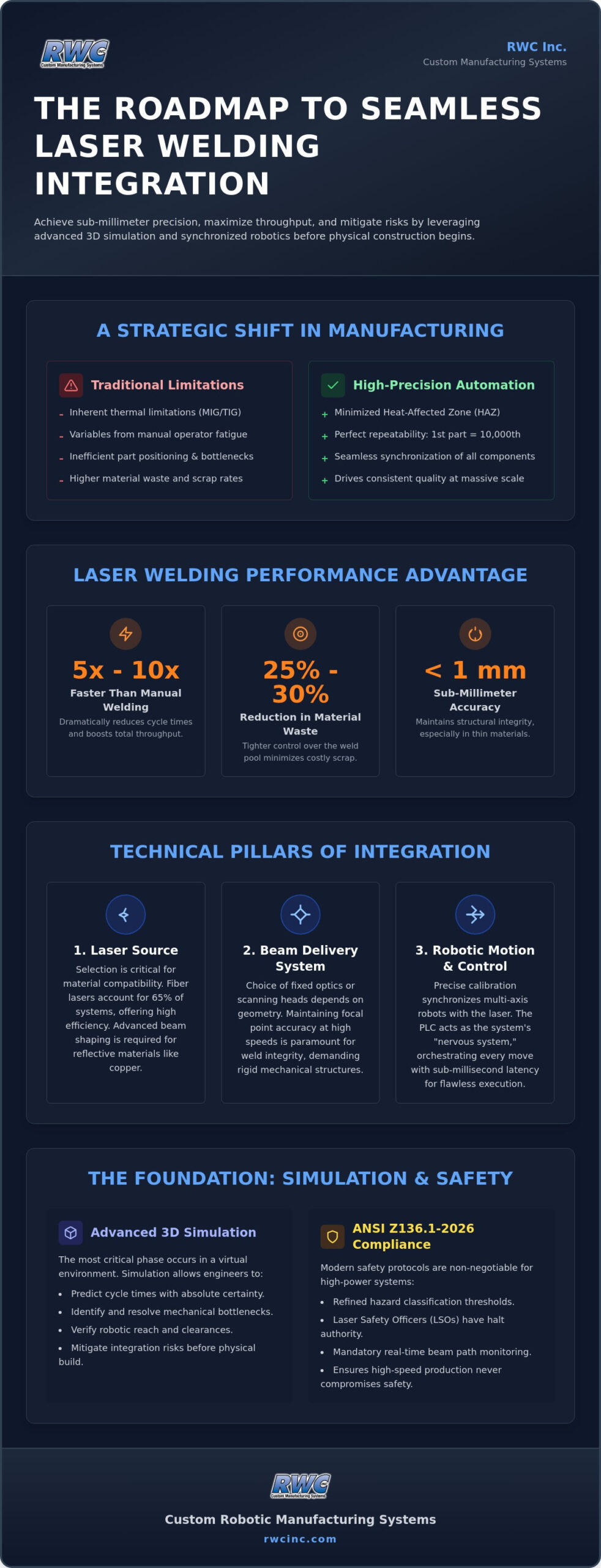
Traditional MIG and TIG automation processes have long been industrial staples, but they carry inherent thermal limitations. Laser beam welding minimizes the heat-affected zone (HAZ), which is critical for maintaining the structural integrity of thin-gauge materials and complex alloys. While manual arc welding is established, laser welding can be five to ten times faster, significantly reducing cycle times and increasing total throughput. Advanced automation solutions drive consistent quality at scale by:
- Eliminating the variables associated with manual welding and operator fatigue.
- Ensuring that the first part off the line is identical to the ten-thousandth.
- Reducing material waste by 25-30% through tighter control over the weld pool.
Identifying the Need for Custom Integration
Does off-the-shelf machinery meet your specific production requirements? Often, standard equipment lacks the flexibility needed for specialized geometry or unique material combinations. This is where custom robotic manufacturing systems provide a decisive advantage. By tailoring the automation to the specific mechanical needs of a project, manufacturers can balance initial capital expenditure with long-term operational efficiency. A custom approach ensures that the laser welding system integration is optimized for your specific floor layout and throughput goals, rather than forcing your process to fit a generic machine’s constraints.
Technical Framework for Laser Welding System Integration
The technical architecture of a high-performance welding cell is built on three pillars: the laser source, the beam delivery system, and the robotic motion platform. Achieving successful laser welding system integration requires these components to communicate with sub-millisecond latency. While fiber lasers account for 65% of systems sold in 2026 due to their energy efficiency, selecting the correct wavelength and beam profile is essential for specific material compositions. For instance, welding highly reflective materials like copper or aluminum often necessitates advanced beam shaping or “wobble” heads to ensure stable penetration and reduce porosity.
Safety protocols have also evolved to match the power of modern systems. The ANSI Z136.1-2026 standard introduces refined hazard classification thresholds and grants Laser Safety Officers (LSOs) the explicit authority to halt operations immediately if protocols are breached. For new Class 4 CO2 systems, real-time beam path monitoring is now mandatory. This rigorous safety framework is a core component of Advanced manufacturing environments, ensuring that high-speed production doesn’t compromise personnel safety.
Robotic Motion and Beam Delivery
Synchronizing a six-axis robot with a laser source requires precise coordinate calibration. If the focal point shifts by even a fraction of a millimeter during high-speed movement, weld integrity is compromised. Engineers must choose between fixed optics, which offer stability for heavy-duty joints, and scanning heads that use galvo mirrors for high-speed “on-the-fly” welding. Maintaining focal point accuracy at speeds five to ten times faster than manual welding demands a rigid mechanical structure and high-resolution encoders. If you’re unsure which delivery method suits your part geometry, you can consult with our engineering team for a technical evaluation.
Control Systems and Software Interface
The Programmable Logic Controller (PLC) acts as the nervous system of the cell, orchestrating the timing between the robot’s position and the laser’s firing sequence. Modern systems increasingly utilize IoT connectivity to integrate laser controls directly with Manufacturing Execution Systems (MES) for cloud-based data logging and remote diagnostics. This connectivity allows for real-time monitoring of parameters such as laser power, gas flow, and travel speed. High-speed software feedback loops prevent weld defects by automatically adjusting laser parameters the moment a sensor detects a deviation from the established baseline.
Mitigating Integration Risks with Automated Machine Simulation
How do you ensure a complex automation cell performs as expected before it ever reaches the plant floor? The answer lies in the deployment of digital twins. By creating a virtual replica of the entire production environment, engineers can identify mechanical bottlenecks and predict cycle times with surgical precision. This pre-build validation is a cornerstone of professional laser welding system integration, as it allows for the testing of robotic reach and collision detection without risking damage to expensive hardware. It’s a proactive approach that transforms potential physical failures into solvable digital puzzles.
Validating throughput in a virtual space provides a level of certainty that traditional planning methods cannot offer. While some competitors suggest a basic roadmap is sufficient, a truly resilient system requires the ability to stress-test the interaction between the laser head and complex workpieces under maximum load. This methodology ensures that when the physical assembly begins, the system is already optimized for peak performance. As noted by the American Welding Society on Laser Welding, the benefits of this technology are only fully realized when the integration is precise and carefully planned.
The Value of 3D Modeling in Design
High-fidelity factory layout simulations allow for the optimization of floor space while visualizing the intricate movements of multi-axis robots. Utilizing 3D modeling services early in the design phase eliminates the need for costly revisions during the build process. For a deeper look at how these techniques apply to large-scale projects, our guide on Industrial 3D Modeling Services details the precision engineering required for modern manufacturing environments. This visual clarity ensures that every component, from safety enclosures to beam delivery systems, fits perfectly within the designated footprint.
Automated Machine Simulation as a Cost-Saver
Simulation serves as a powerful financial safeguard by significantly reducing commissioning time. Instead of debugging code on a live production line, engineers can refine the logic in a virtual space, ensuring that the software and hardware are perfectly synchronized. This process reduces the reliance on expensive physical prototypes and prevents the “trial and error” approach that often leads to budget overruns. By the time the laser welding system integration moves to the physical phase, the control logic has been rigorously tested, leading to a faster transition to full-scale production and a more predictable return on investment.
Synchronizing Robotic Manufacturing Systems with Laser Cells
The transition from a virtual simulation to a physical production environment requires a methodical execution of robotic handshaking and timing. Successful laser welding system integration isn’t achieved by simply connecting hardware; it’s the result of a rigorous five-step synchronization process. First, engineers must establish a master-slave relationship where the robot controller dictates the path while the laser source responds with instantaneous trigger signals. This ensures the beam is only active when the robot is at the precise velocity and position required for a stable weld pool. Precision starts with this digital handshake.
Calibration follows as the second critical step. Coordinate systems must be aligned with sub-millimeter precision to ensure the Tool Center Point (TCP) of the laser head matches the robot’s internal map. Once the motion is perfected, auxiliary processes like metal piercing or adhesive application are integrated into the sequence. The fourth step involves implementing robust safety interlocks and light curtains to protect personnel without impeding workflow. Finally, a comprehensive runoff is conducted to validate that the system meets the pre-defined throughput and quality benchmarks before full-scale production begins.
Multi-Process Integration
Modern assembly lines often require more than just a single joining method. In many structural applications, combining laser welding with industrial adhesive bonding assembly provides superior vibration damping and seal integrity. Managing the transition between metal piercing and welding operations within the same cell reduces part handling and minimizes the risk of misalignment. Automated fixturing plays a vital role here, ensuring that the workpiece remains perfectly stationary as the robot navigates complex geometries and multi-process transitions.
Workflow Optimization
Maximizing uptime requires a focus on the peripheral systems that support the laser. Automatic lens cleaning stations and nozzle change systems prevent debris from compromising the beam quality, which is essential for high-volume runs. Efficient gas delivery and fume extraction are equally important; they protect the optics from contamination and ensure a clean environment for the welding process. Robotic tool-changing increases the versatility of a single welding station by allowing the arm to swap between a laser head, a gripper, or an adhesive dispenser as the production cycle demands. This flexibility ensures your investment remains adaptable to future product changes.
Lifecycle Excellence: Beyond the Initial Integration
Does the completion of a physical build signal the end of the engineering journey? For high-performance facilities, the initial laser welding system integration is merely the commencement of a long-term operational lifecycle. High-precision lasers are sophisticated instruments that require meticulous upkeep to maintain their sub-millimeter accuracy over thousands of production hours. Without a structured approach to lifecycle management, the efficiency gains achieved during the simulation phase can quickly erode due to component wear or miscalibration.
A resilient operation relies on the immediate availability of custom replacement parts and expert machine service. For high-quality industrial components and specialized metal fabrication, you can learn more about Profimetal. While some providers focus solely on the point of sale, a sustainable strategy requires a partner with a dedicated inventory of critical components. This proactive stance ensures that if a lens becomes contaminated or a robotic encoder fails, the impact on production throughput is minimized. Remote diagnostics and cloud-based troubleshooting now allow for real-time intervention, often resolving software conflicts or parameter drifts before they manifest as physical weld defects.
Maintenance and Technical Support
Future-Proofing Your Automation Investment
Scalability is a fundamental requirement in a market defined by rapid product iterations. A well-integrated system is designed to be adaptable, allowing for the introduction of new product variants without requiring a complete overhaul of the cell architecture. This adaptability is maintained by updating 3D simulations as production needs evolve, ensuring that new weld paths are validated in the virtual space before implementation. Software and firmware upgrades further enhance robotic performance, providing access to improved motion control algorithms and safety features. Continuous optimization ensures that your automation investment remains a competitive asset for years to come.
Partner with RWC Inc. for your next custom robotic integration
Securing Operational Excellence in Automated Welding
Successful implementation of high-precision automation requires a transition from reactive problem-solving to proactive virtual validation. By prioritizing 3D modeling and automated machine simulation, manufacturers can eliminate the technical hurdles that often lead to integration errors and production delays. This strategic approach ensures that laser welding system integration becomes a predictable driver of throughput rather than a source of operational risk. It’s about establishing a foundation where precision is guaranteed before the first part is ever processed.
Since 1945, RWC Inc. has served as a steadfast guide for industrial leaders across the nation. Our expertise in multi-axis robotic synchronization and in-house simulation capabilities provides the foundation for systems that are both high-performing and adaptable. Beyond the initial build, our commitment to full lifecycle support and a dedicated inventory of replacement parts ensures your facility maintains its competitive edge for years to come. We don’t just build machinery; we engineer long-term manufacturing resilience.
Take the next step toward a more efficient and predictable production line with a partner who understands the high stakes of industrial engineering.
Frequently Asked Questions
What are the main benefits of laser welding system integration over manual welding?
Laser welding offers significantly higher throughput and superior precision compared to manual arc welding. Integrated systems can operate at speeds five to ten times faster while reducing material waste by approximately 25% to 30%. This efficiency is achieved through a minimized heat-affected zone, which preserves the structural integrity of the workpiece. By removing human variability, manufacturers achieve a level of repeatability that’s essential for high-volume industrial scaling.
How does 3D modeling reduce the risks associated with custom machine building?
3D modeling allows engineers to identify and resolve mechanical bottlenecks in a virtual environment before physical construction begins. By simulating the interaction between the robotic arm and the workpiece, we eliminate the risk of costly design revisions and equipment collisions. This pre-build validation ensures that the final machine footprint is optimized for your facility’s floor space and production flow, protecting your capital investment from unforeseen mechanical errors.
Can laser welding be integrated into an existing production line?
Yes, laser welding system integration can be designed to interface with your current production environment and material handling systems. Custom robotic engineering allows us to develop cells that synchronize with existing factory execution systems (MES) for seamless data logging and control. This approach ensures that the new automation cell enhances your current workflow without requiring a total overhaul of your existing infrastructure or facility layout.
What is the difference between fiber laser and Nd:YAG laser integration?
Fiber lasers have largely replaced Nd:YAG systems in modern integration due to their superior energy efficiency and beam quality. A fiber laser is typically 30% more energy-efficient and offers a more stable focal point during high-speed robotic movement. These characteristics make fiber lasers the preferred choice for applications requiring deep penetration or high-speed “on-the-fly” welding in complex assembly lines where reliability is paramount.
How long does a typical robotic laser welding integration project take?
The timeline for a laser welding system integration project typically ranges from four to twelve months, depending on the complexity of the custom engineering required. This duration includes the initial 3D modeling phase, automated machine simulation, physical assembly, and the final runoff at your facility. Each stage is meticulously managed to ensure the system meets your specific throughput and quality benchmarks upon delivery to your plant floor.
What safety standards are required for industrial laser welding cells?
Industrial laser cells must comply with the updated ANSI Z136.1-2026 safety standards for the safe use of lasers. These regulations mandate the use of appropriate safety enclosures, light curtains, and real-time beam path monitoring for Class 4 systems. Additionally, facilities must designate a Laser Safety Officer (LSO) who has the explicit authority to halt operations if safety protocols are breached, ensuring a secure environment for all personnel.
How does automated machine simulation improve cycle time accuracy?
Automated machine simulation uses digital twins to map exact robotic paths and laser firing sequences with sub-millimeter precision. This allows engineers to predict cycle times with absolute certainty before the system is built. By stress-testing the control logic in a virtual space, we eliminate the time-consuming trial and error process that often occurs during the physical commissioning of a new welding cell, resulting in predictable production throughput.
Does RWC Inc. provide replacement parts for custom robotic systems?
RWC Inc. maintains a dedicated inventory of replacement parts to ensure the long-term reliability of every custom system we build. Our lifecycle support services include proactive part replacement strategies and expert machine service to minimize unplanned downtime. We understand that securing a reliable supply chain for custom components is critical for maintaining the high-throughput performance and operational integrity of your automation investment over its entire lifespan.

